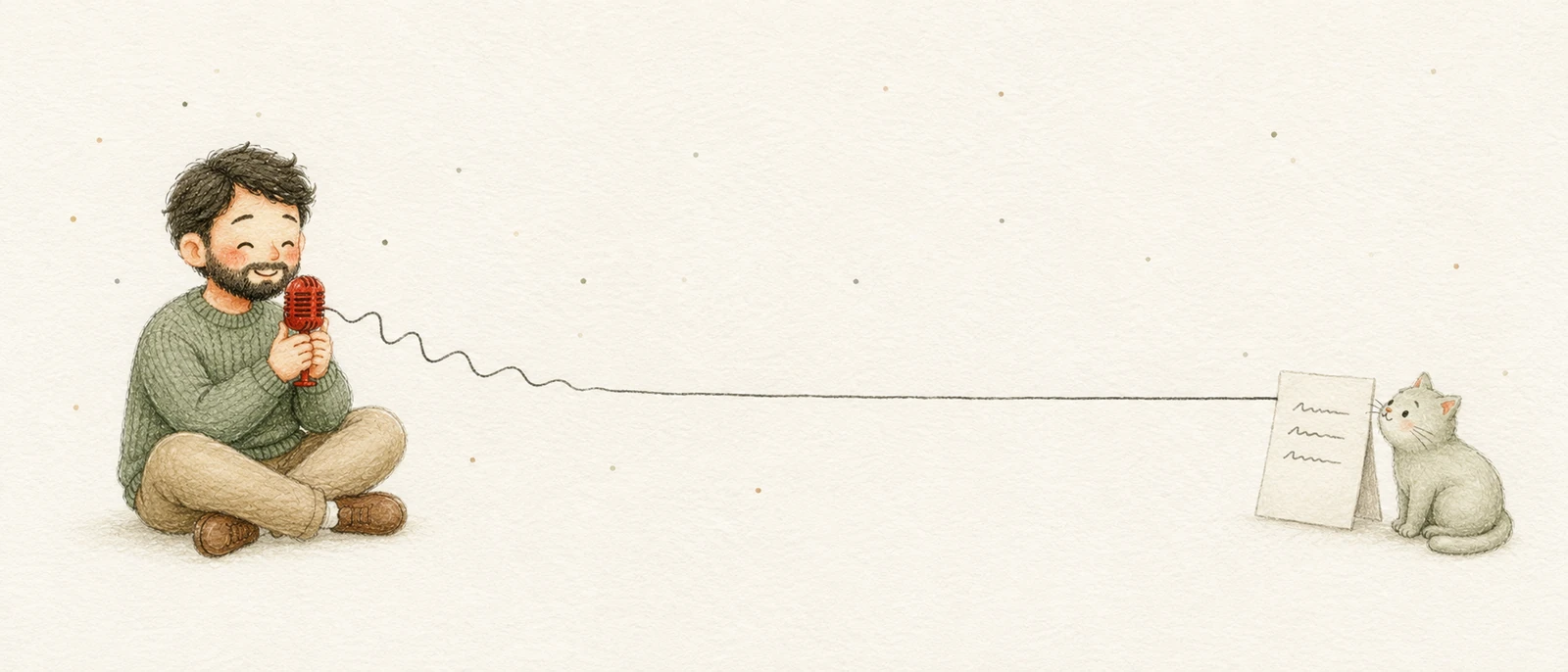
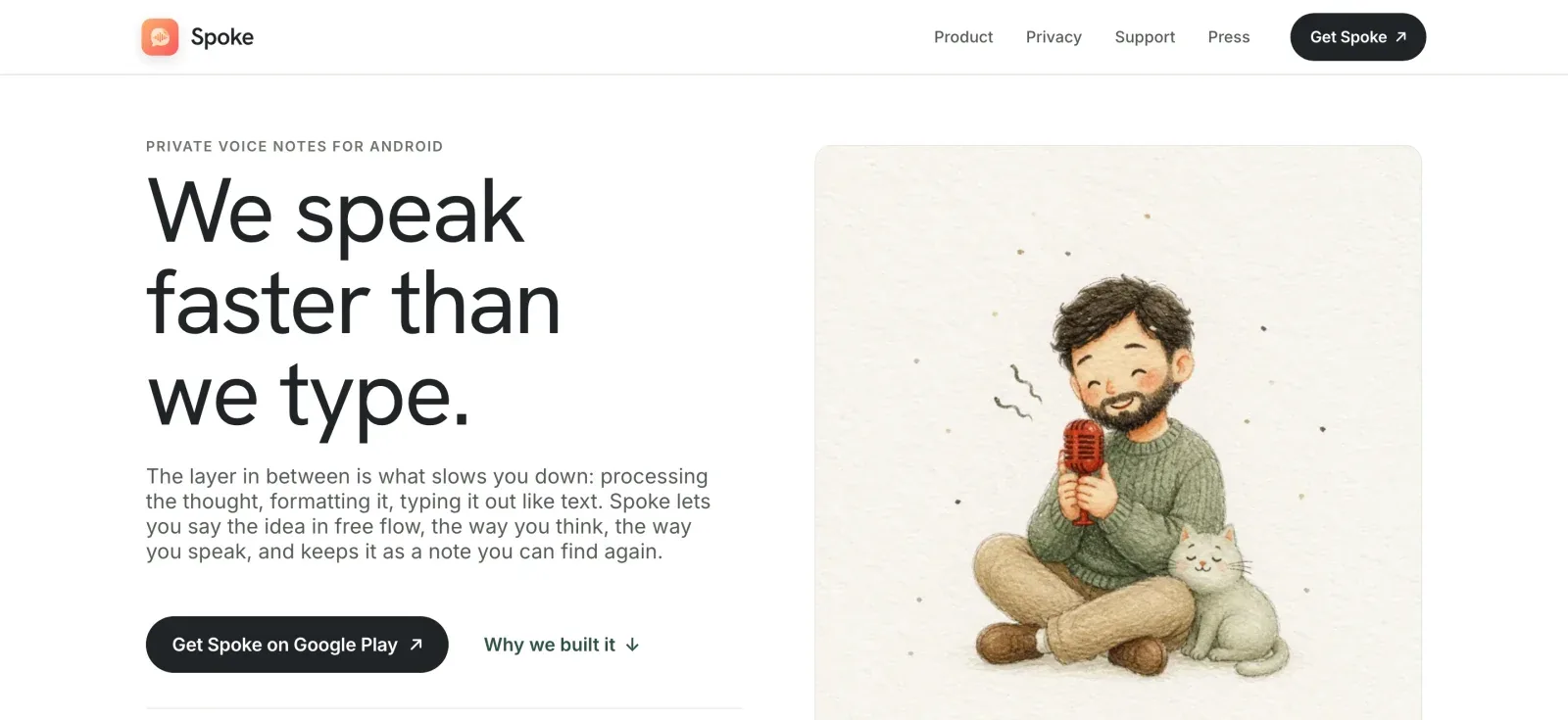
We speak faster than we type.
Spoke is a private voice notes app for Android. You say the idea the way it arrives, Spoke writes it down on the phone itself, and the words are there when you search for them later.
The problem
A thought arrives as speech, dies in typing, and the tools that could catch it want your voice on their servers.
The eureka moments never arrive at a desk.
Walks, drives, the minutes before sleep. That is where the good thinking happens, and that is exactly where typing fails it. A few close friends and I had settled into a habit of leaving each other voice notes, because saying an idea keeps it alive. The layer in between is where it dies: processing the thought, formatting it, typing it out like text.
When I shared the idea of building an app around the habit, the reaction I got was not excitement. It was fear. Three worries came back, in almost the same words every time.
- “My voice could be cloned.”
- “My information might get leaked.”
- “Models are getting trained on all of this.”
Those three sentences became the brief. Not a transcription app with privacy settings. A private app that happens to transcribe.
The answer
Trust you can check, not trust you have to take.
The three lines at the top of the landing page are the architecture, not the marketing. Audio never leaves your phone. No account to start. Text syncs only when you sign in. Each one is a promise the code keeps.
On your phone
- You say itrecording starts the moment you do
- Audio saves wholethe recording is the note, kept first
- A local model writes iton the phone, no network involved
- You find it and actexact search, tasks, weekly review
Only when you sign in
- The words syncthe audio stays where it was made
The writing is Whisper, an open speech model packed down until the phone can run it: 16 transcription languages, Hinglish first among them. Transcription is not a service the audio travels to. It is a thing the phone does.
The loop
Catch it, keep it, find it, act on it.
The shipped screens, in the order a thought moves through them.
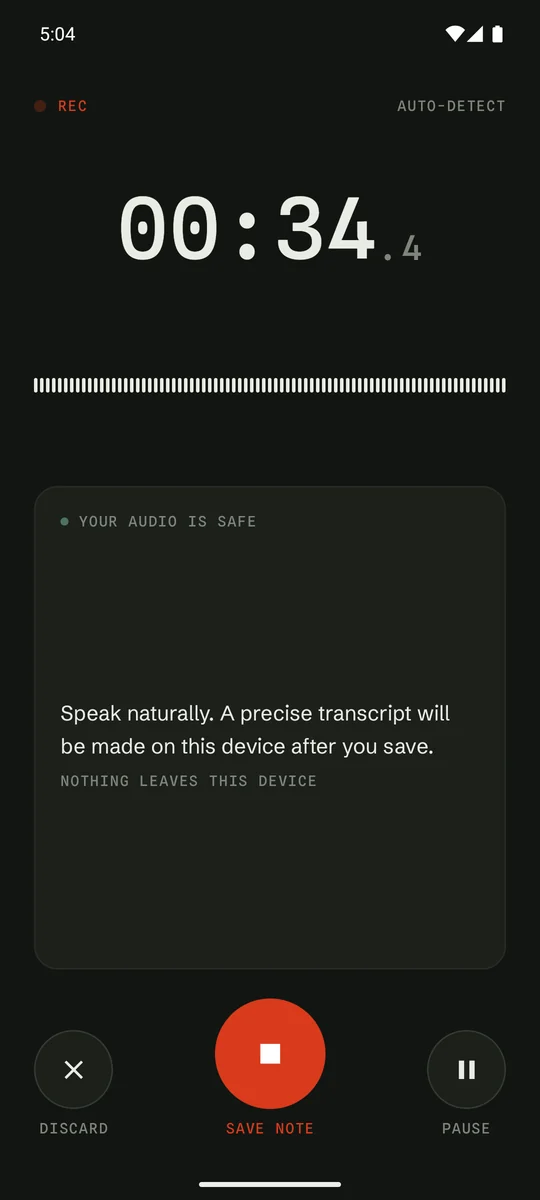
Say itRecording starts the moment you do. Home stays visible underneath.
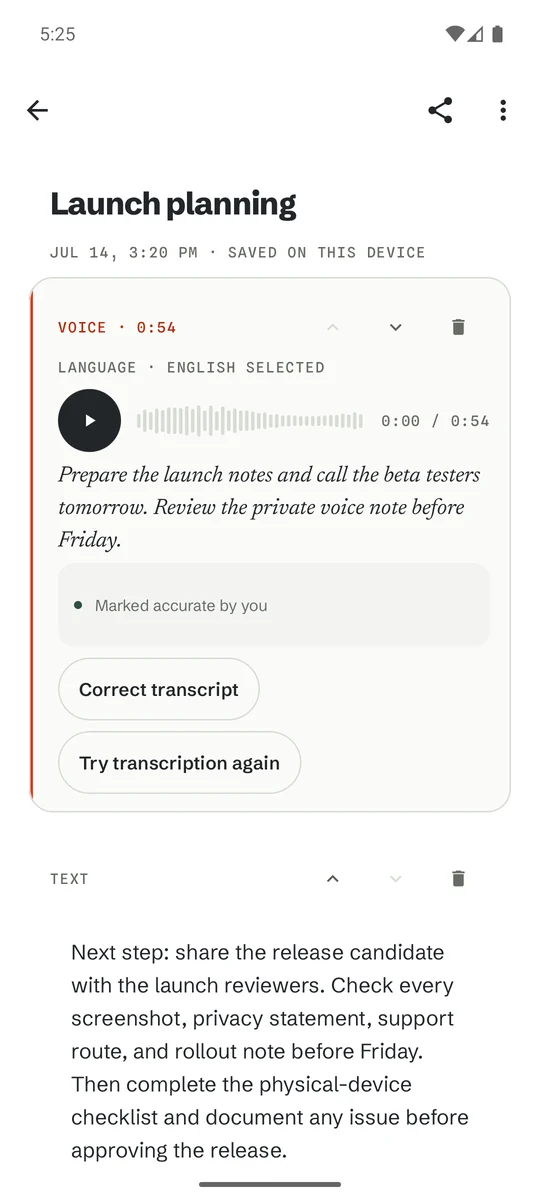
Voice becomes inkA local model writes the transcript on the phone itself.
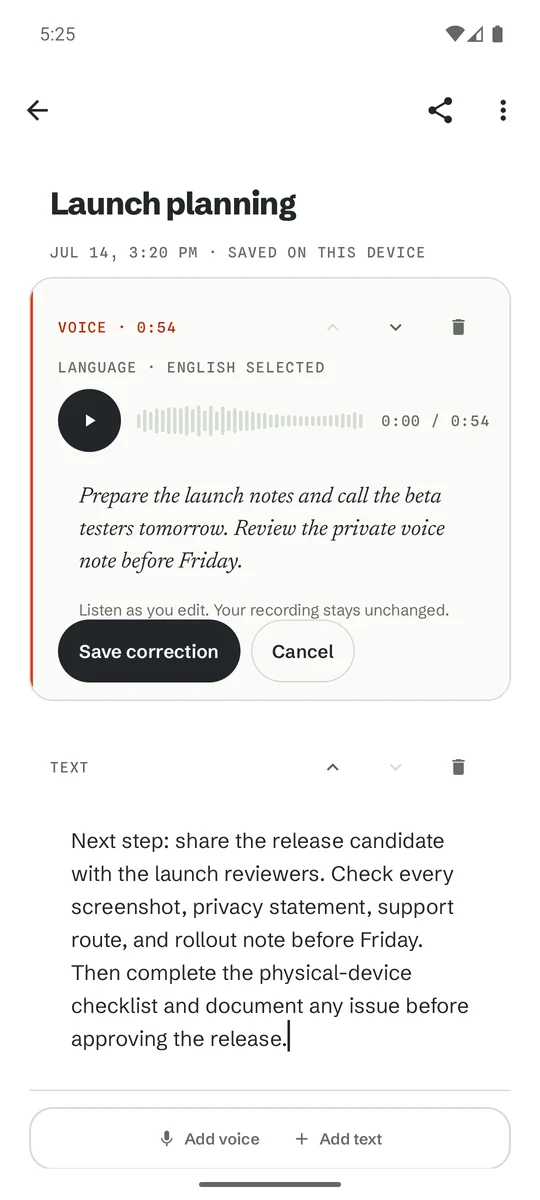
Check it against the tapePlayback beside the words, so the text earns your trust.
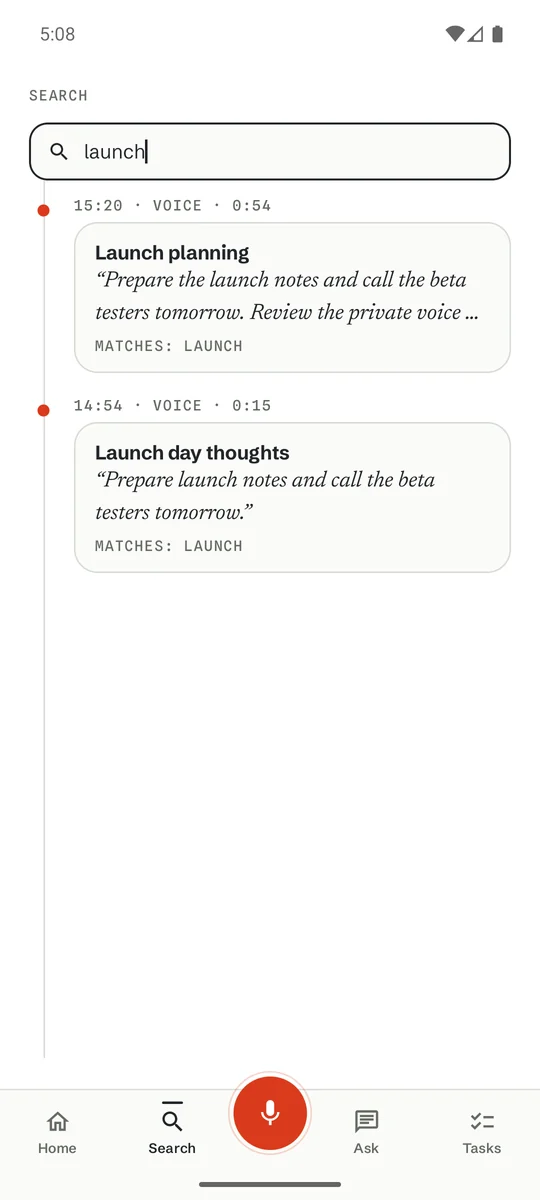
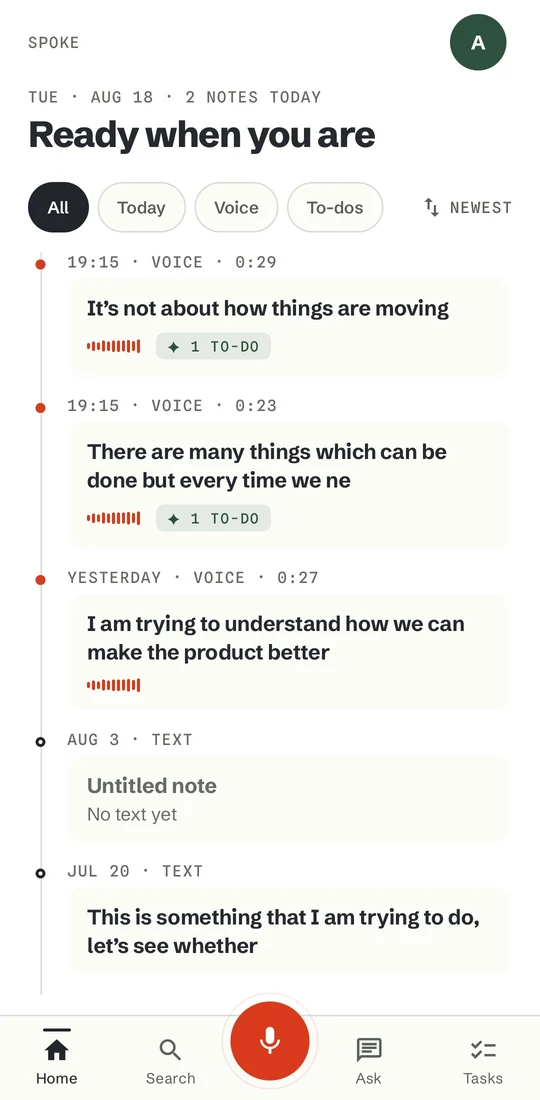
One word finds itExact search across everything you ever said.
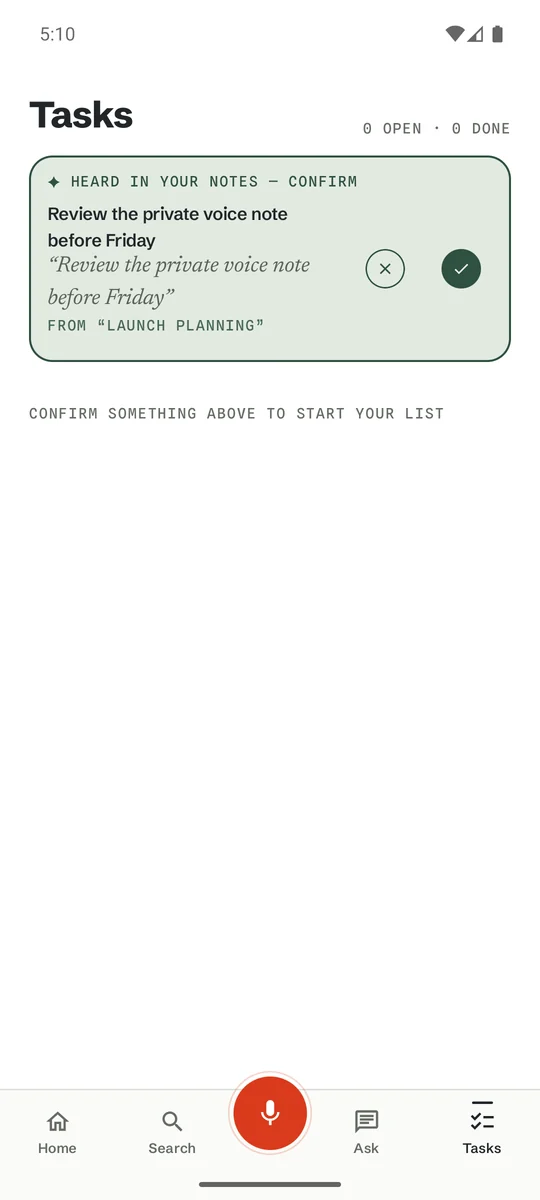
Ideas become doingSuggested tasks wait for an explicit yes before they exist.
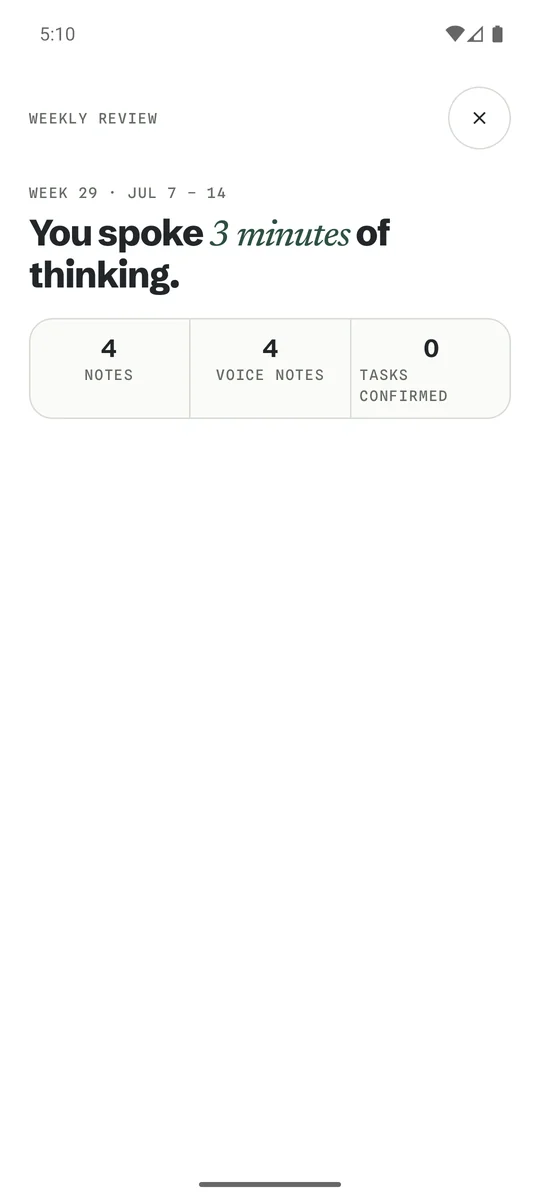
A quiet look backA weekly review of themes and open loops, computed offline.
The design system
One rule carries the interface: voice becomes ink.
The system is called Ink & Porcelain, and it is built on provenance. On any screen, at a glance, you know what came from your voice, what you edited, and what the machine measured.
Colour follows the same discipline. One red, and it may only ever mean recording. One green, and it may only ever mean AI. No gradients anywhere. The dark theme is not an inversion but a warm graphite tuned by hand, and the palette is locked by a unit test: slip below the accessibility floors and the build fails.
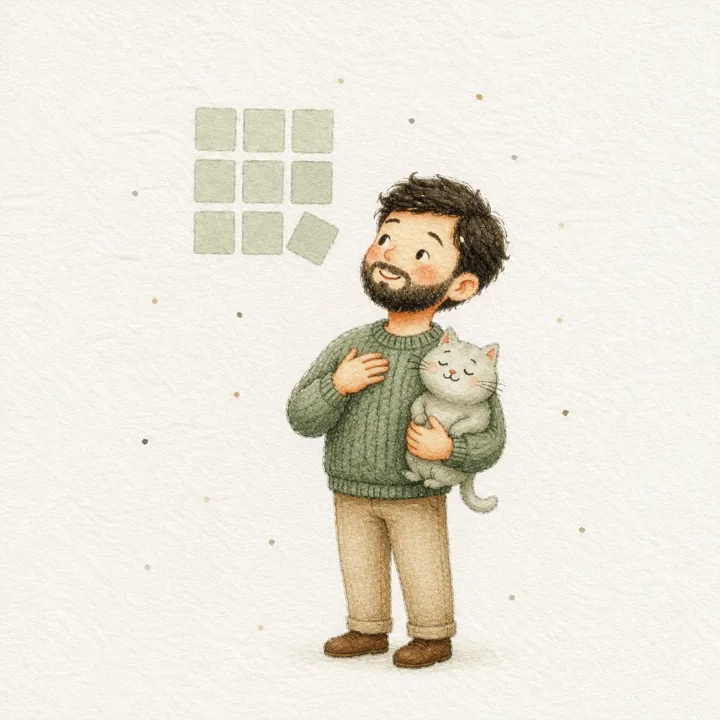
Precision alone reads cold, so the system carries a warmth layer: storybook watercolor illustrations for the empty moments, a recurring cast of a man in a sage cable-knit and his pale sage cat. The discipline holds inside the artwork too. The vintage handheld microphone is the only red object ever painted.


The decisions
Halfway in, I audited my own product. It did not pass.
Two months of fast building produced an app that demoed well and wobbled in the details. I wrote the audit the way I would write one for a client: a strong 0.8 of a product, most of the way there, with trust-breaking seams in capture, in what counts as a note's source, and in a paywall that promised more than it could sell. The strategy after that day was two words, trust before breadth, and the decisions that followed all subtract.
Kill the live transcript.
A streaming recognizer typed the words while you spoke, and it demoed beautifully. It also only really worked in English. Indian English, Hindi, and Hinglish came out wrong, and a saved note that misquotes you teaches you to stop trusting every note. I removed it from the capture path. Audio saves whole first, then the model writes a transcript it can stand behind. A working feature went, because it lied.
Recording starts before anything downloads.
The first release greeted a new install with roughly 160 MB of speech model before the app had done the one thing it exists to do. Version 1.1.0 flipped that: you can record straight away, and nothing downloads until you ask. I also refused the quiet fix of fetching the model automatically on Wi-Fi. Unmetered is not free, and a tethered hotspot reports as Wi-Fi.
Free stays whole. Pro sells the AI.
Spoke sells a subscription now, and the paywall opens by admitting the app is useful before Pro. Everything that catches and keeps a note is free for good. Pro adds the AI that works from your own notes. One launch line got cut, a promise of longer recordings, because no such limit exists in the build. Copy must not sell what the build does not do.
Spoke Pro
Spoke is useful before Pro.
Yours free, forever
- Voice capture & on-device transcription
- Editing, tasks, exact search, export
- Offline weekly review
With Pro
- Ask, with note-backed receipts
- Create and transform drafts
- Related-idea recall & weekly observations
Shipping it whole
The mark, the film, the site: one product.
A product is not just its screens. The launcher mark went through three explored directions before the porcelain speech bubble shipped. The launch film runs 59 seconds, storyboarded from ten painted stills. And the landing page keeps the promise before you ever install: it makes zero third-party requests until you press play on the film, and a test fails the site if that ever changes.
Under all of it: Kotlin and Jetpack Compose, and on-device speech recognition. The engineering matters here for one reason. It is what makes audio never leaves your phone true at the code level, not just in the copy.
What this proves
An early product, claimed at its real size.
Install numbers are deliberately not claimed. The claim is the judgment: what got built, and what got cut.
What carries forward
Trust is a design surface.
Every decision that made Spoke more trustworthy was a subtraction: the live transcript that went, the download gate that went, the paywall line that promised too much. What carries forward is provenance, showing people where a thing came from, and the habit of writing down what may be claimed before claiming anything. That is the same instinct my enterprise work runs on.
Role and credit: Spoke was designed, built, and shipped end to end by me under my independent label, Studio Kunj. My close friends were its first users, and its conscience.
Ask AI about this case Live
Answers come from what this case actually says. Pick a lens, ask as many as you like.
Summarize this case
1. The eureka moments never arrive at a desk. Spoke catches a thought by voice and writes it down on the phone itself: private by architecture, not by policy.
2. One rule carries the interface, voice becomes ink: spoken words render in italic serif, typed words in grotesk, so you always know what came from your voice.
3. The hard decisions subtract: a working live transcript was killed because it misquoted Hindi and Hinglish, the first-run model download went, and a paywall line that promised too much got cut before launch.
4. Designed, built and shipped solo to Google Play, with the film, the site and the store listing. An early product, so the claim is judgment and end-to-end ownership, not scale.