 SereneAI writing editor
For the five seconds before you hit send.
Serene is a Chrome extension I positioned, designed and shipped on my own. It reads the draft already on your screen and offers a rewrite before you send, so the message lands the way you meant. It lives where you already write, you approve every word, and your writing never leaves your device.
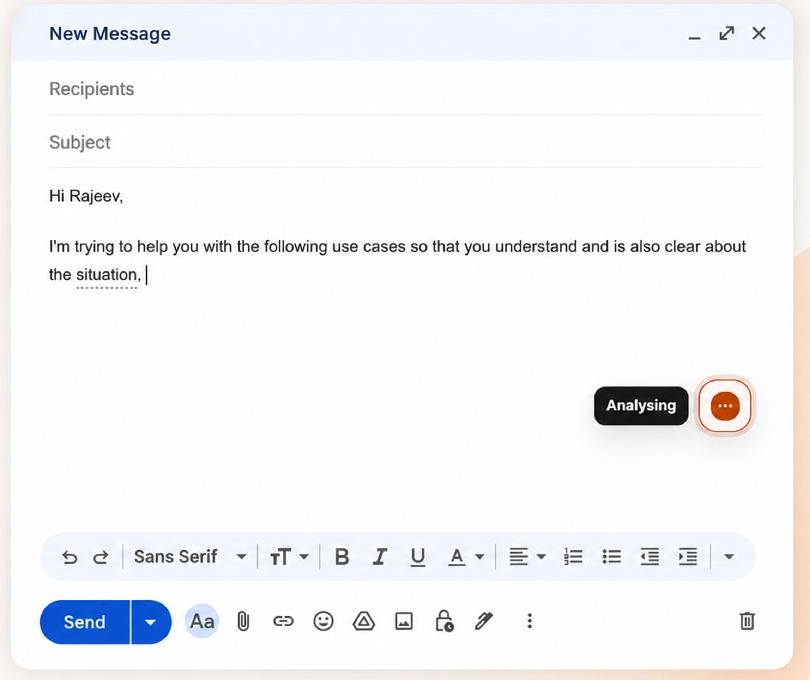
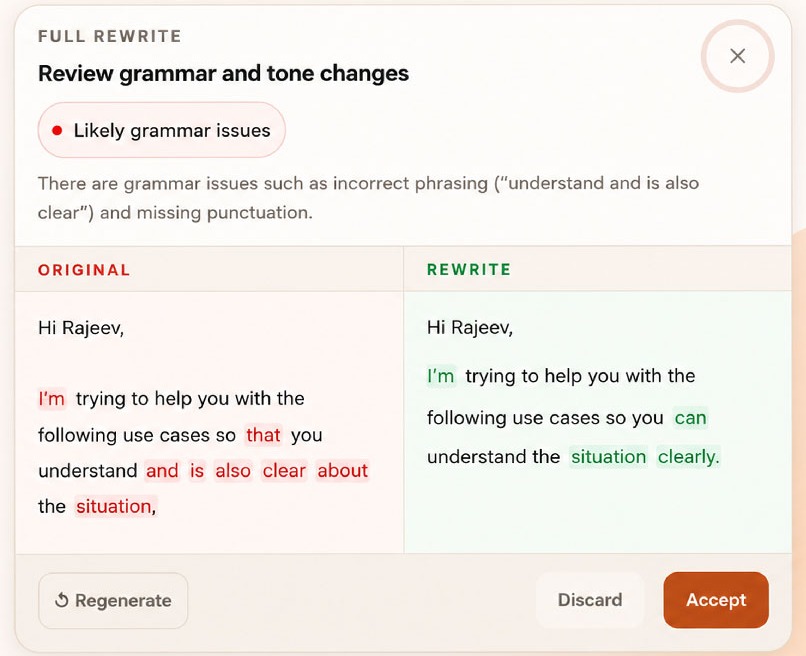
Hi Rajeev, I'm trying to help you with the following use cases so that you understand and is also clear about the situation,
Hi Rajeev, I'm trying to help you with the following use cases so you can understand the situation clearly.
Edited, not generated
02 /The problem
Most writing problems aren't grammar errors. They're tone gaps, the moments a message lands differently than you meant.
You know what you want to say. The trouble is the distance between what you meant and what the reader will feel, the almost-right message. It's not misspelled, it's just slightly off, and you feel it in the five seconds before you hit send. The people who feel it most write all day in the browser: client email, LinkedIn, support notes, outreach. They care how they sound, but won't stop to fix it, and won't paste confidential drafts into a public AI tool.
“This sounds sharper than I meant.”
“I know what I want to say. I need it to land cleanly.”
“I am not pasting client details into another tool.”
Representative voices, paraphrased from the recurring complaint.
of what employees paste into ChatGPT is sensitive data, and client data leaks about 260 times a week for every 100,000 workers. As Cyberhaven put it, “the average company leaks confidential material to ChatGPT hundreds of times per week.”
Cyberhaven Labs, 1.6M workers · cyberhaven.com
“Human brains are still the best tools in the content writer's tool kit, and they should always look over ChatGPT-generated work.”
A whole class of tools now exists just to make generated text sound human again. Serene starts from the other end, editing what you already wrote.
Nielsen Norman Group, 2024 · nngroup.com
03 /Why nothing else fits
The fix already exists three ways. Each one costs you something.
Leave the page, strip anything confidential, paste, copy back, reformat. By then the momentum is gone.
Serene works inside the field. You never leave the draft.
Great for grammar and spelling. Not built for tone, clarity, or the human read of a message.
Serene rewrites for how it lands, not just whether it's correct.
You reread it three times, still aren't sure, and either send it or overthink it into a worse draft.
Three rewrites are free. The first takes five seconds.
It never writes for you.
Serene takes the words you already chose and closes the gap to the ones you meant. It never sends anything on its own, and the draft stays yours.
04 /How it works
It lives in the text field, and hands the decision back to you.
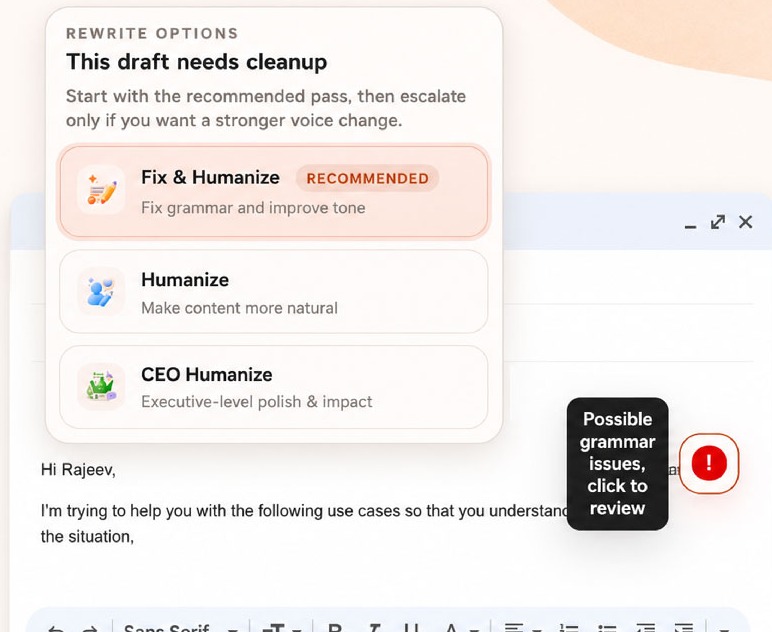
With no new tab and no copy-paste, Serene reads the draft when you pause and shows a small state icon right where you're working. One tap opens the reads, and every rewrite is a diff you approve before a single word changes.
Reads the draft in place
Flags grammar or tone
You pick a read
Review the diff
Keep it, or don't
05 /How it rewrites
Four reads of the same draft. You choose which one goes out.
Cleans grammar and softens tone in one pass.

Loosens stiff, formal drafts so they sound like a person.

Cuts hedging. Says it directly, without losing you.

Light touch-up. Same draft, just sharper.
- Vary the rhythm. Mix short, medium and long sentences on purpose.
- Kill AI tells. Strip moreover, furthermore, additionally, one per paragraph, at most.
- Add one concrete detail. Micro-specificity over generic phrasing.
- Hedge like a human. Often, tends to, in many cases, not sterile certainty.
- Keep the meaning and the length. A rewrite, not a rewrite of you.
- Allow small imperfections. Correct, never over-polished.
06 /The decision I kept fighting for
A floating dot reads as a bug. A rewrite you didn't ask for reads as a takeover.
The first build dropped a coloured dot near the field after analysis. It floated, it lingered, and it looked like something had broken. Worse, early rewrites replaced your text in place, the one thing a writing tool must never do without asking. Two changes fixed both: an inline icon that lives inside the field (the way a password manager does, clearly intentional and clearly yours to tap), and a suggestion card you accept or discard, never a silent replacement.
Detached from the field, no affordance, no resolution path. Reads as a glitch, not a feature.
07 /Private by architecture, yours by design
Your writing never reaches us.
The whole product falls apart if a founder doesn't trust it with a client email. So trust isn't a policy here, it's the architecture.
Sees the draft, draws the UI. Never sees your API key.
Holds the key in device storage. The only file that makes the call.
The rewrite happens on your account. The text never routes through us.
Nothing is read or sent in the background. Your text is processed the moment you request a read, and not a moment before.
A flat yearly price, no seats, no recurring lock-in. You approve every word before it touches your draft.
08 /The page that earns the install
I built the landing page as an argument. Each block answers the next objection, and the layout does the persuading.
Pick a block to see how that part of the page is built to communicate.
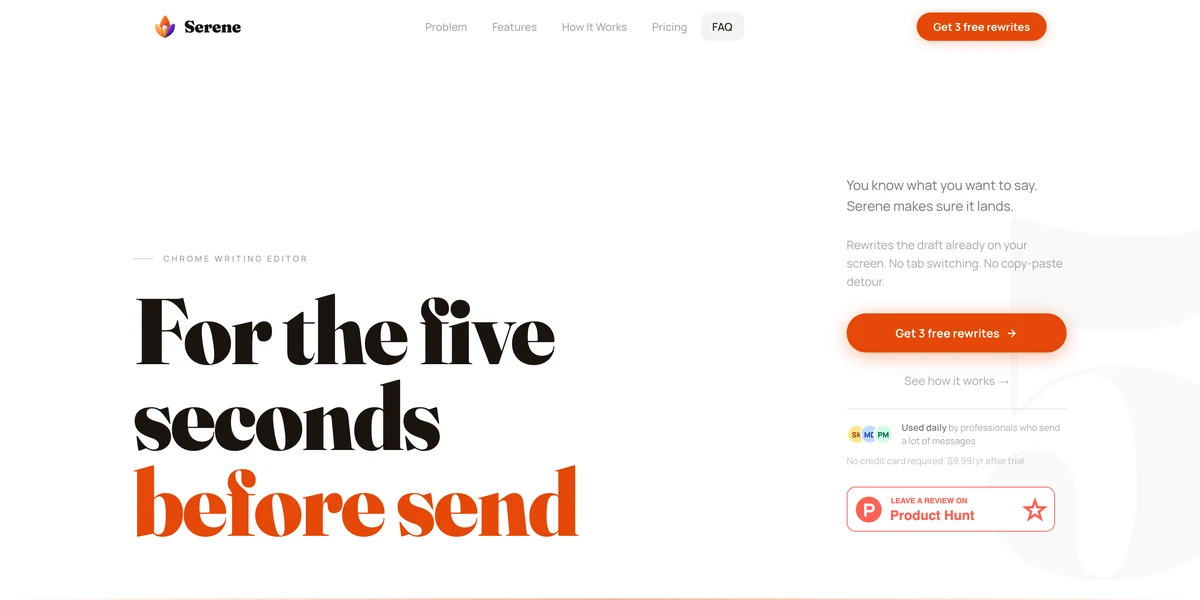
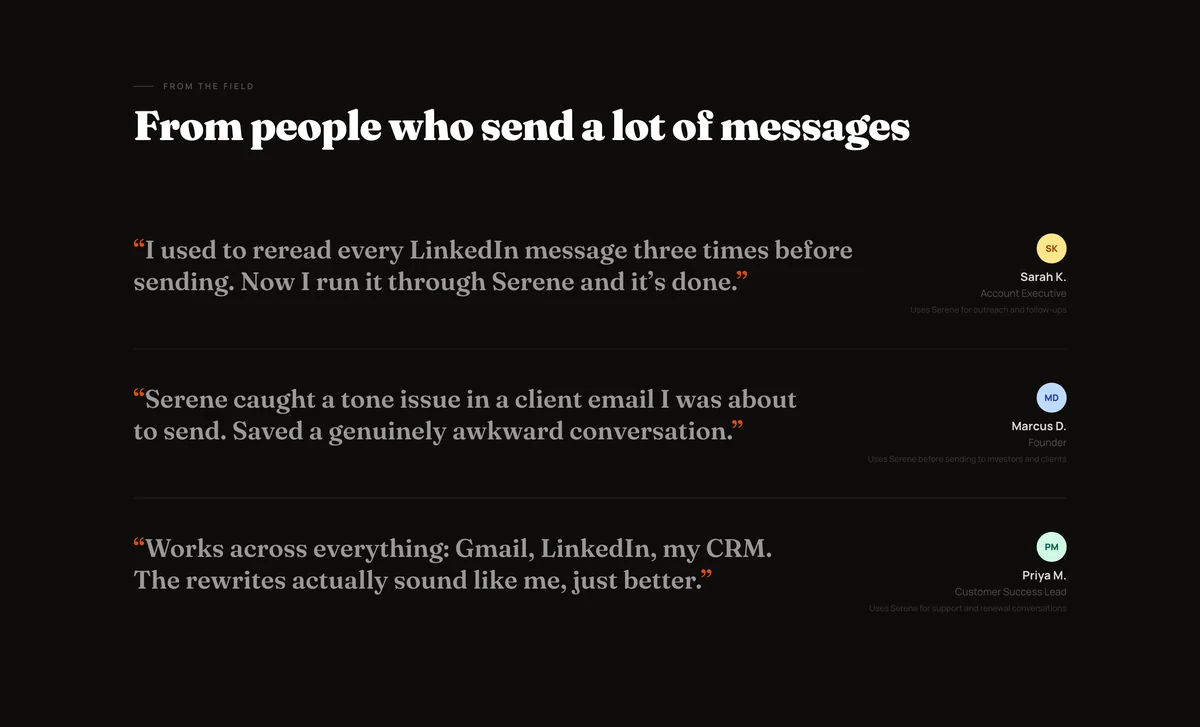
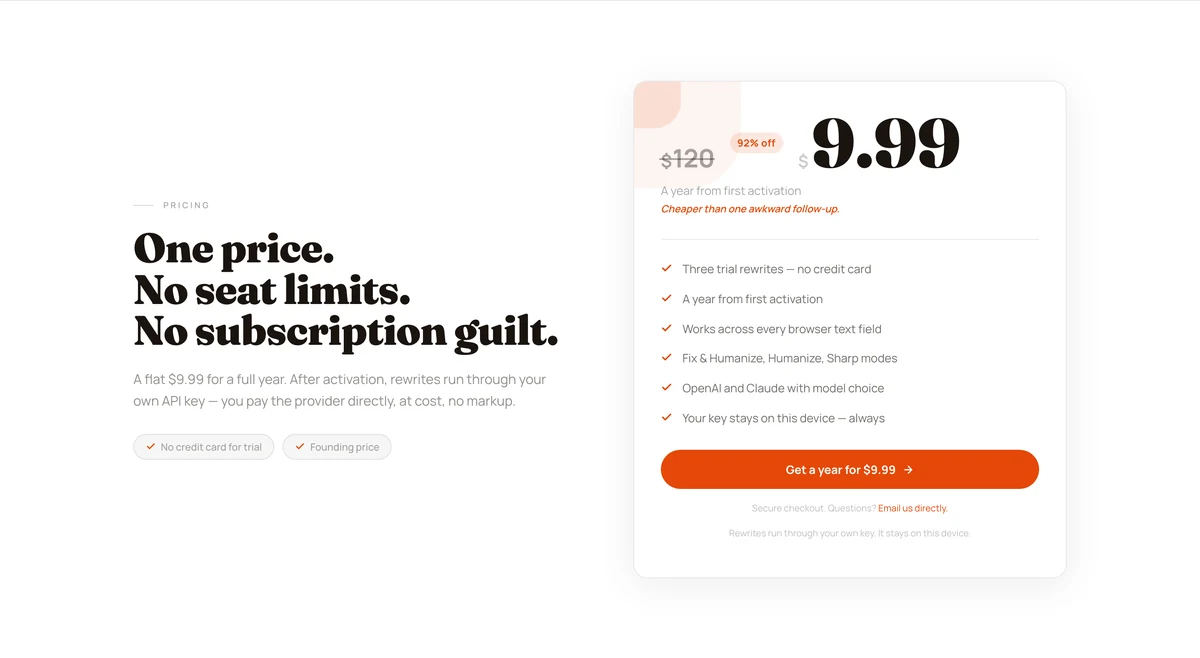
The hook. A serif headline names the feeling, not the feature. The value stack and the primary action share the right rail, so the pitch and the first click sit together above the fold.
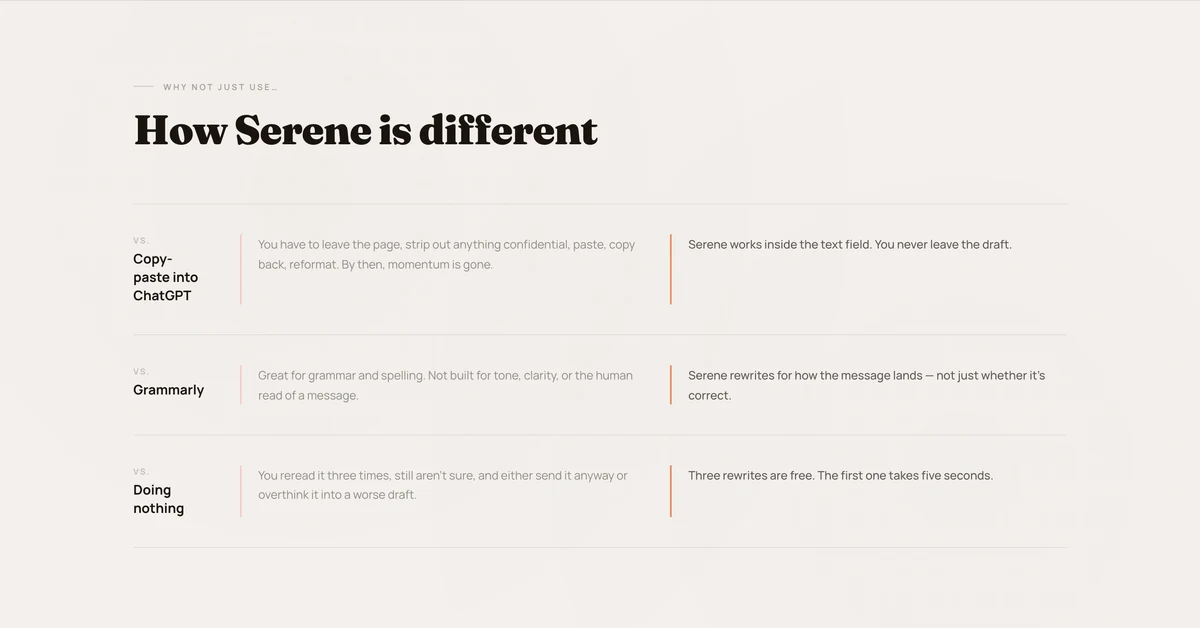
The difference. Three alternatives, each with its cost: leave the page for ChatGPT, settle for Grammarly, or do nothing. The reader rules out the competition on their own.
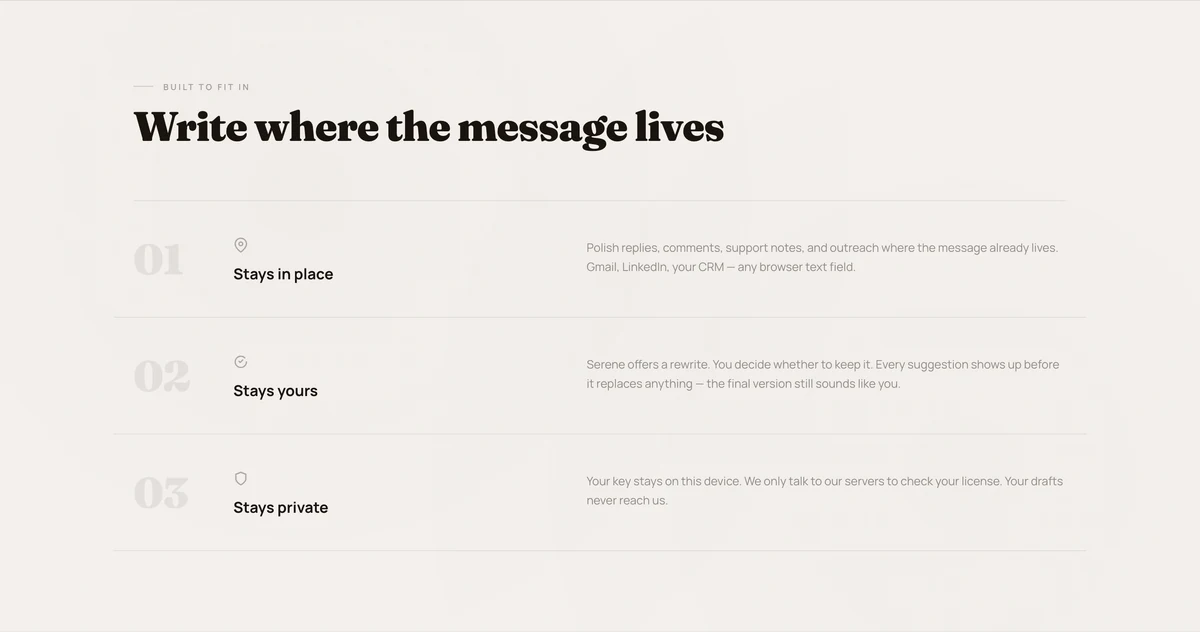
Built to fit in. Three promises, one word each: stays in place, stays yours, stays private. It answers the disruption worry and the safety worry in the same breath.
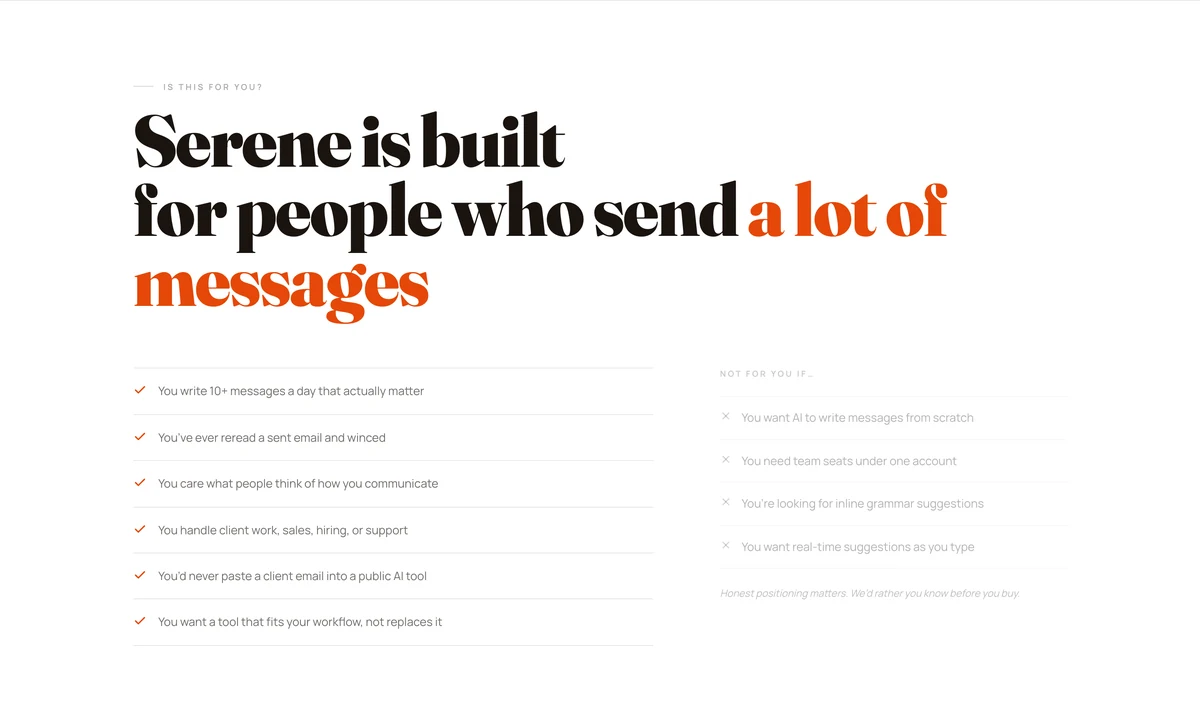
Is this for me? A for-you list beside a not-for-you list. Naming who it is not for, out loud, earns more trust than claiming it is for everyone.
From the field. A dark band interrupts the light page, so the quotes read as a different voice. Role tags carry the credibility, not star ratings.
One price. One number, stated plainly, with the founding discount shown once. No seat matrix, no toggle, no subscription. The offer is the closing argument.
Same case as the product, made in type instead of code. I designed and shipped both.
09 /What this proves
End to end, on my own.
Serene is the whole stack in one person's hands: the insight, the positioning, the product design, the extension, a small serverless backend, the pricing, and the landing page that sells it.
An early product with a small install base. The claim is range, not scale.
10 /What carries forward
The confidence of a second read, without the cost of a second opinion.
I built Serene because I kept doing the same thing: writing a message, reading it back, feeling like it didn't quite land, then pasting it into ChatGPT and back, four steps for a thirty-word email. The goal was never to replace how you write. It was to give a considered draft the confidence to go out. That instinct, remove the friction, keep the person in control, and earn trust in the architecture, not the copy, is the one I carry into every product.
Role and credit: Serene was positioned, designed, built, and shipped end to end by me under my independent label, Studio Kunj.
Ask AI about this case Live
Answers come from what this case actually says. Pick a lens, ask as many as you like.
Summarize this case
1. Most writing problems aren't grammar. They're tone gaps, the almost-right message you feel in the five seconds before send.
2. Serene is a Chrome extension that edits the draft in place. It reads the field, flags grammar or tone, and offers a rewrite you approve as a diff. Edited, not generated, and private by design, so your key and your words never leave your device.
3. The landing page that sells it is mine too, built as an objection-handling argument that earns a skeptic's trust before the install.
4. Positioned, designed, built (extension and serverless backend), priced and shipped solo under Studio Kunj. An early product, so the claim is range and full-stack ownership, not scale.