The price on a listing is not the price you pay.
Buying a home in India hides a second price tag. Around thirty extra costs, registration, stamp duty, maintenance, parking, society charges, quietly add twenty to thirty percent to the real number, and most buyers meet them too late. In 2018 at 99acres I designed a tool that worked out the true cost of owning a home before a buyer ever picked up the phone.
02 /The problem
The sticker price is a comfortable lie.
A property is advertised at one number, but the amount that actually leaves a buyer's account is another. Registration, stamp duty, maintenance, parking, development charges, society and corpus funds, all of it stacks up, and it stacks up differently for every property. Working the real figure out takes a fluency in real estate and taxation that most buyers do not have, so the gap shows up as a surprise at exactly the wrong moment, when a buyer is deciding whether they can afford the place at all.
03 /How I thought about it
Earn the structure, don't guess it.
Thirty tangled cost factors is exactly the kind of problem where it is tempting to invent a structure and move on. Instead I ran an open card sort and let the structure come from how people actually group these costs, then organised and aligned the result. Five buckets carried the whole messy pile, and they became the spine of the tool.
- Configuration (BHK)
- Property type
- Super built-up area
- Possession
- Tower, phase, floor
- Preferential location
- Club membership
- Corner / facing
- Maintenance
- Car parking
- EDC
- Power back-up
- Stamp duty
- Registration
- Legal charges
- Corpus fund
- Advertisers
- Channel partner
- Builder
- Payment plans
The five-column architecture that came out of the card sort. Items shown are representative of each bucket.
Then a flow that matched how a buyer actually decides.
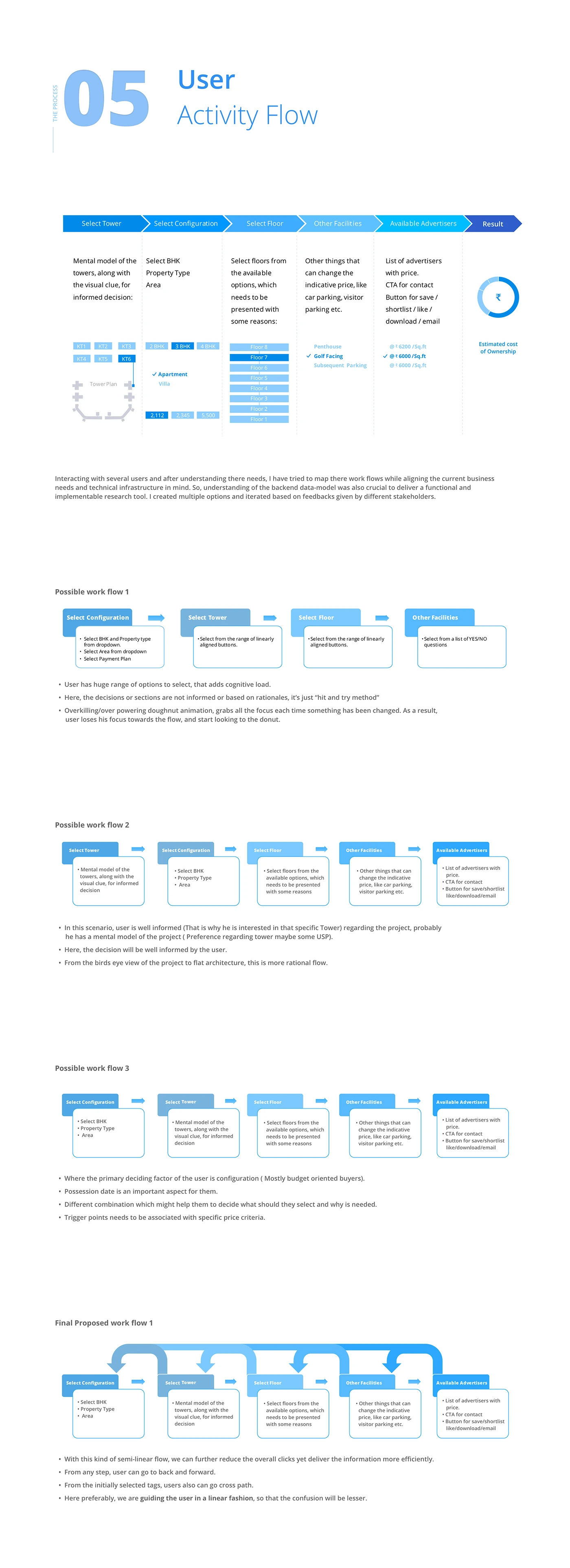
On top of the architecture sat a guided flow. The first draft followed the data, not the person, and started with configuration, a huge range of options that overwhelms the buyer before they have their bearings. I rewrote it across three critiqued versions until the order matched a buyer's mental model, starting from the building they already picture and narrowing down to the specific home, then to the cost.
Tower
Configuration
Floor
Other facilities
Available advertisers
True cost result
04 /The decision I'm proudest of
I killed a loading animation I liked.
An early version had a satisfying doughnut-style loader on the results step. It looked good, and that was the problem: it grabbed the focus and pulled the buyer off the one thing they came for, the number. So it went. On a research tool, anything that competes with the answer is a cost, not a delight. The honest critiques are written right on the boards in my own hand: “adds cognitive load,” “just a hit and try method,” “a more rational flow.”
05 /The work
From the raw cost pile to a finished tool.
The original case boards, as they were made: the problem and the card sort, the flow iterations with their critiques, and the wireframes through to the final screens.


06 /What I take from it
The method is the point.
This is research and product thinking from early in my career. The boards do not show whether the tool shipped or any funnel it moved. What they do show: a structure earned from a card sort instead of invented, a flow reordered to fit a person rather than a database, and the willingness to cut something I liked because it got in the buyer's way. That last instinct has only sharpened since.
Role and credit: research and product design at 99acres in 2018, on an enterprise project with a wider team.
Ask AI about this case Live
Answers come from what this case actually says. Pick a lens, ask as many as you like.
Summarize this case
1. A listing's price hides 20–30% in registration, taxes, maintenance and society charges, and buyers meet them too late to plan for.
2. I ran an open card sort to earn a five-part structure for the ~30 cost factors, then reordered the flow to match how a buyer decides, and cut a loader that stole focus from the answer.
3. There is no outcome metric to claim. The value is the method: research-led structure, a flow rebuilt across honest critiques, and the instinct to cut what gets in the way.